
Trees in cities can improve health, reduce the urban heat island effect and mitigate the worst effects of climate change. Read on to see what we can do as individuals…
As I write this, the temperature outside is in the mid-thirties Celsius. It is regularly hotter in summer than I ever remember as a child. Of course, everything is remembered through a rose-tinted veil. But the evidence supports my memory – summers are not only hotter and drier than they were 50 years ago, but heatwaves are also becoming more extreme, longer lasting and more frequent. It seems inevitable that 40oC summers will become a regular event in our cities, at least in the south of the country. This is not good news. According to the Office for National Statistics, the 2022 heatwave (which recorded 40oC) killed an estimate 2083 people in London alone. Extreme heatwaves are bad for everyone, but can be deadly for the very young, very old or those with medical conditions.
High temperatures are bad for mental health. A brilliant document called ‘Greener, Cooler, Healthier’, released on 21 June 2026 outlines the links between Mental Health and heat stress. The report highlighted that ‘Exposure to extreme heat was associated with a 6% increase in inpatient admissions and a 7% increase in community mental health teams (CMHTs) compared to normal temperature conditions’. This is hardly surprising, but it is interesting to see it quantified – there has not been enough research into the links between climate breakdown and mental health. What we do know, is that access to green spaces has a positive effect on mental and physical health. There is lots of research on this – over a thousand papers – and much of the evidence is collated in Dr Kathy Willis’s excellent book ‘Good Nature’. So it is hardly surprising to learn that higher levels of residential greenness significantly mitigated the impact of extreme heat on admissions for mental and behavioural disorders.
Sue James of TDAG ponders that if only we could invent something that (amongst other things) provides urban cooling, reduces flood risks, improves mental and physical wellbeing, enhances biodiversity, improves air quality and enhances property values into the bargain. Her point is of course that trees do all of these things. Unfortunately, our street trees are under increasing pressure. Litigation-shy councils concerned about subsidence and trip hazards, underground service contractors, drought, pests and diseases all threaten our trees. It is not unusual for trees to be cut down for one of these reasons and not replaced.
So what is the answer – what can we do? The first thing is to remember that it is not all about street trees – although we’ll come back to these. Trees in private land (gardens, principally) and other open spaces are also vitally important. Clients need to be encouraged not only to keep existing trees as much as possible, but also to plant more. If you include tree canopies, over 50% of London is covered by blue or green. Parks and gardens are a key part of that, so you should include trees in your schemes whenever you can.
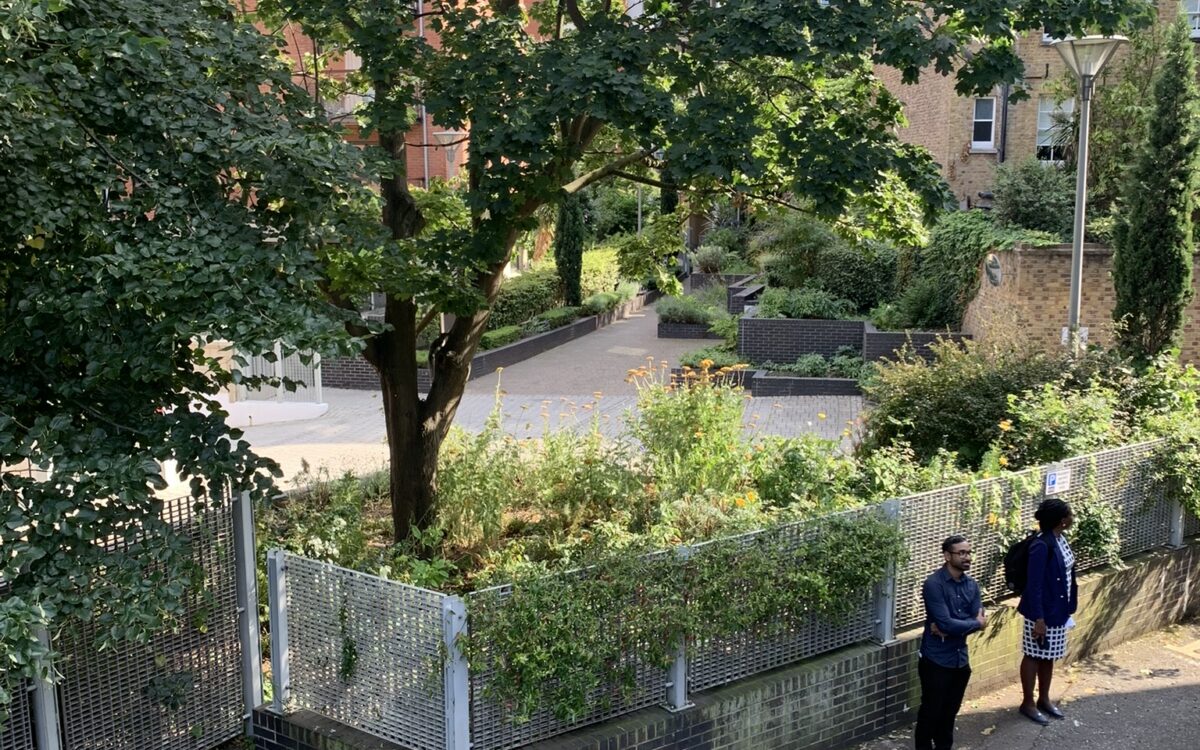
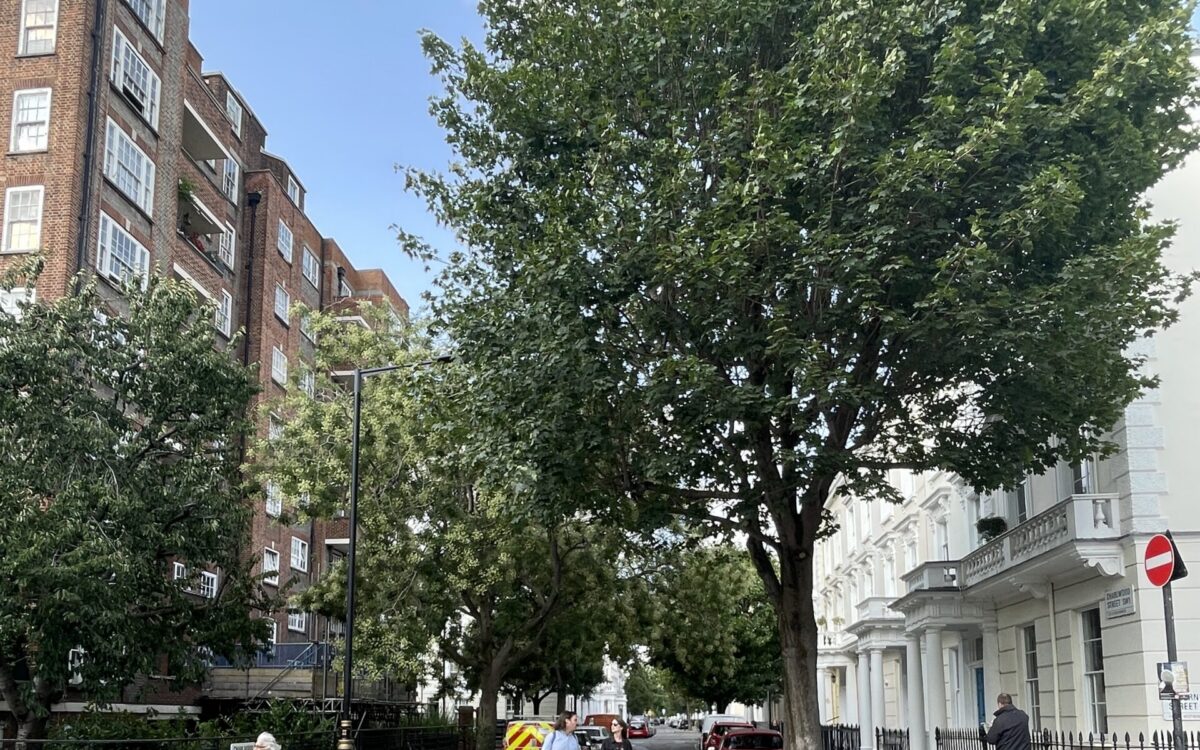
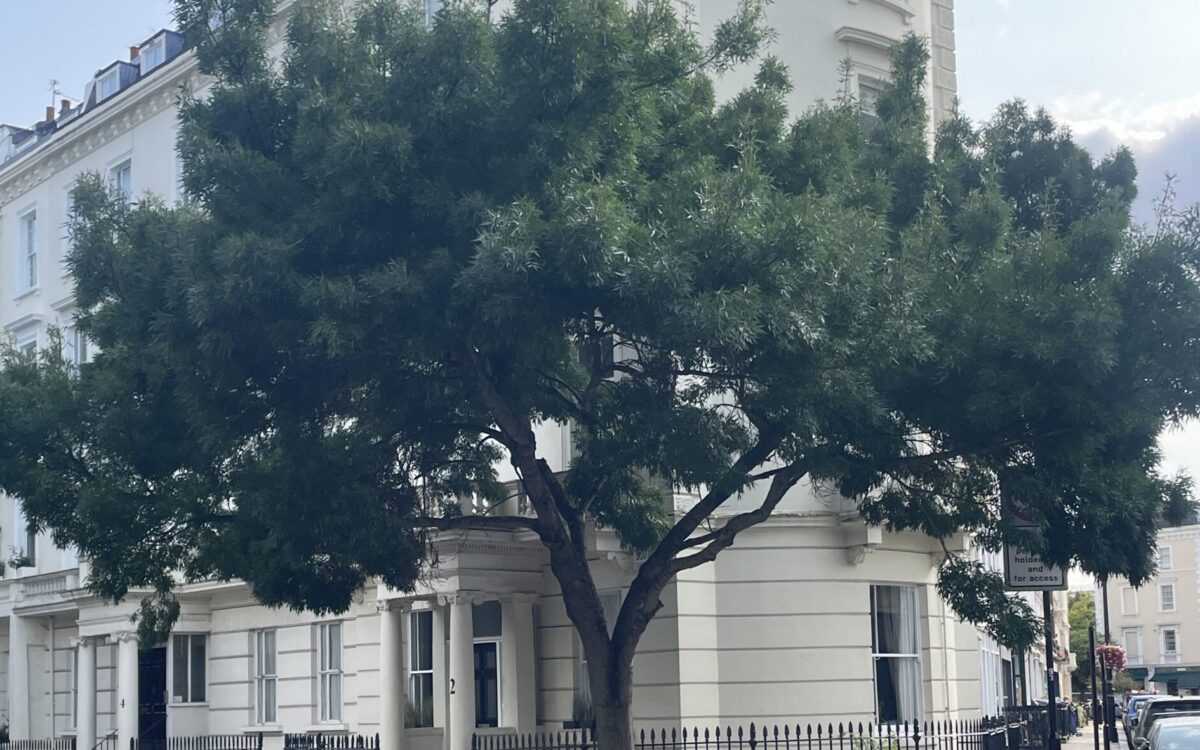
Many local authorities are doing great work here. I took a short walk through Pimlico in the London Borough of Westminster a few months ago and counted more than twenty different street tree species – all the photos in this blog are taken from that walk. We can all get involved with boosting street trees in our local neighbourhood. ‘Trees for Streets’ is a great organisation that facilitates this. You can search their website in seconds to see whether your local authority is participating and if not, submit a form to persuade them.
Street trees are part of the answer, but they work best when incorporated into rain gardens or bioretention systems. These help keep the trees watered and allow gas exchange as well as reducing flood risk. Grey to Green (in Sheffield) is the most famous UK example of this, but smaller scale plantings work just as well – indeed, they are an essential part of the mix. As cars in our cities reduce, space for planting at the edges of roads increases, along with opportunities for alfresco drinking and dining. On a recent visit to Copenhagen, I saw plenty of these underway. The low-lying Danish Capital has reduced its flood risk by 30-50% through a number of measures like this under its ‘Cloudburst Management Plan’. Pocket parks and green roofs also played a part.
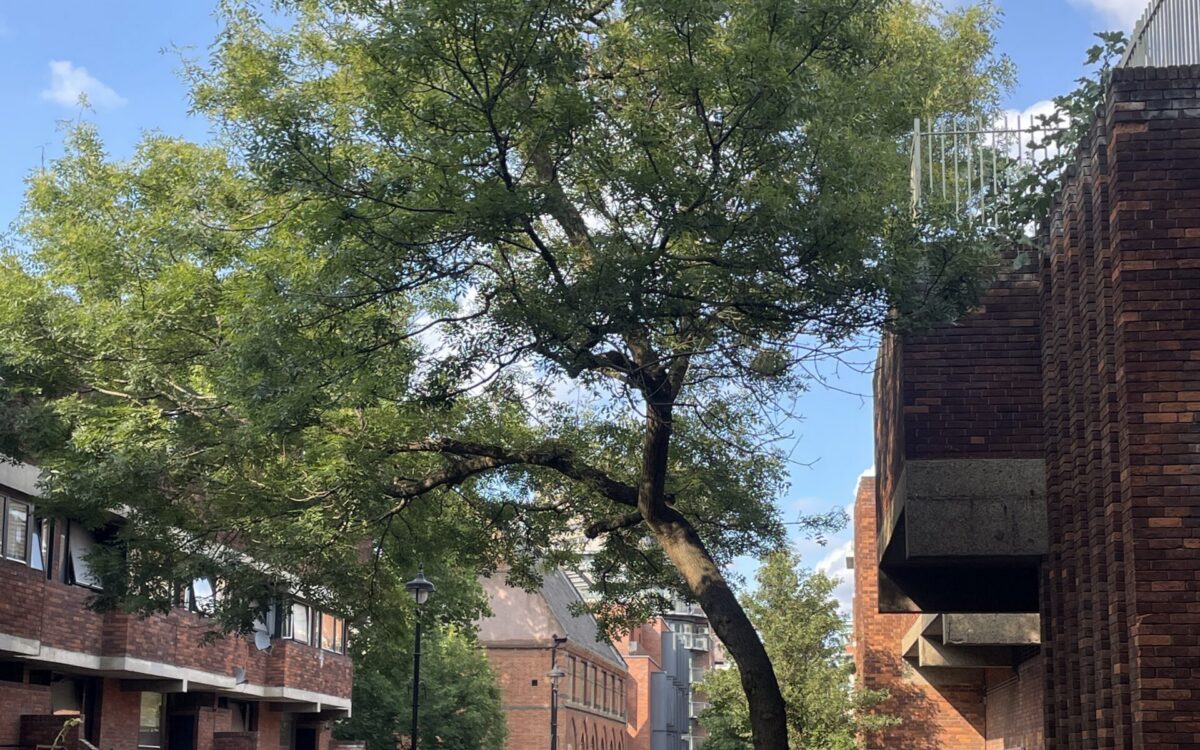
But with the Climate breakdown that we are seeing, how will our traditional UK trees cope? It’s true that some species may not be viable. Shallow rooting trees like birches, beech, cherries, ash, and sycamore are all likely to suffer as we get hotter summers. London Planes manage of course, but Oaks are more tolerant too, especially Quercus frainetto and Q. ilex. Field maples are good and particularly suitable for tighter or secondary locations. There are also lots of other ‘non-native’ species that thrive in cities – Koelreuteria paniculata and Liquidambar styraciflua are particularly resilient. Lots of good advice can be found in Andrew Hirons and Henrik Sjöman’s 2019 book ‘Tree species selection for green infrastructure – a guide for specifiers’. Downloadable from the TDAG site or available as a paper copy. Henrik also published the more recent ‘The Essential Tree Selection Guide’ with Arit Anderson – packed with good detail.
This is one of the very real ways we as a profession can have a positive impact on urban environments and climate mitigation.
So get out there and take a stand for trees!
September 3, 2026


